
 EST
EST

Your shoes have a bigger climate impact than you might think. Every pair you buy generates emissions – from the farm or oil well to the factory floor, your front door, and eventually the landfill. But not all footwear is created equal, and a few smart choices can dramatically shrink your footprint.
The lifecycle of a shoe’s carbon footprint
A typical pair of shoes generates around 6.7 kg of CO₂ from cradle to grave, according to current footwear manufacturing data. But that number varies wildly depending on materials, construction, and how long you wear them. MIT’s lifecycle assessment found that a pair of sneakers can emit up to 13.6 kg of greenhouse gases – roughly the same as running a 100-watt light bulb for a week.
Here’s how emissions break down across a shoe’s life:
Manufacturing is the heavyweight, accounting for about 1.5 kg CO₂ per shoe – the single largest contributor. Energy-intensive processes like injection molding, stitching, and bonding materials all add up fast.
Materials pack their own punch. Synthetics derived from petroleum (polyurethane foams, nylon uppers, rubber compounds) carry a hefty footprint. Leather production involves land use, methane from livestock, and chemical-intensive tanning. Even “eco-friendly” materials require processing and transport.
Transport adds another layer of emissions. Shipping from factories in Asia to stores in the US or Europe – usually by container ship – is measurable but relatively small compared to manufacturing.
Use phase is surprisingly small! Unless you’re machine-washing sneakers weekly (which breaks them down faster), the emissions here are minimal. This means how long you wear your shoes matters more than how you wear them.
End of life is where things get grim. Only about 5% of post-consumer shoes get recycled. Most end up in landfills, where synthetic materials sit for centuries. The good news? Mail-in recycling programs don’t meaningfully increase a company’s carbon footprint compared to disposal.
How barefoot shoes stack up
Barefoot shoes typically clock in lower on the carbon scale. Why? They use less material (thin, flexible soles instead of chunky foam stacks), simpler construction (fewer glued layers and components), and often more natural materials like leather, wool, or organic textiles.
Take boots with leather and textile uppers, lamb wool lining, and natural rubber soles. No petroleum-based foam cushioning, no complex air pockets or gel inserts. Just straightforward, durable materials that do the job with less environmental overhead.
The real win comes from durability. A well-made barefoot boot can last years of daily wear because there’s less to break down – no compressed foam to flatten, no thick tread to wear through unevenly. Product lifetime dramatically affects environmental scores: the longer you wear a pair, the lower the per-wear emissions. Your five-year-old boots have a fraction of the footprint of three pairs you cycled through in the same period.
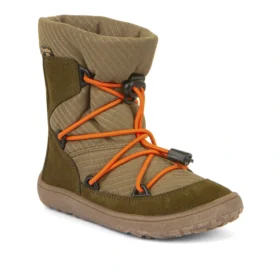
Froddo Barefoot Tex Track Wool Olive (2024) winter boots
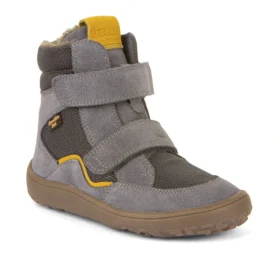
Froddo Barefoot Tex Winter Grey T (2024) winter boots
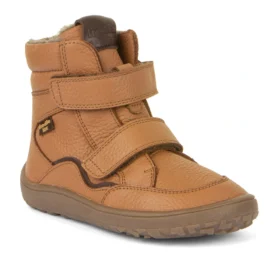
Froddo Barefoot Tex Winter Cognac (2024) winter boots
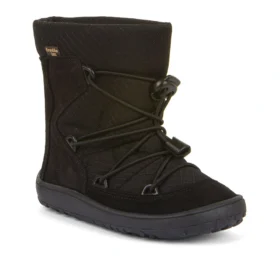
Froddo Barefoot Tex Track Wool Black (2024) winter boots
Materials that matter most
Not all materials are equal. Here’s the quick rundown:
Leather carries a high upfront footprint (livestock farming, tanning) but is extremely durable. Chrome-tanned leather is worse; vegetable-tanned or chrome-free options are better. Mukishoes uses chrome-free leather that reduces chemical impact while maintaining longevity.
Wool is natural, biodegradable, and warm. The embedded carbon is moderate but offset by longevity and end-of-life breakdown – it won’t sit in a landfill for 200 years.
Synthetics (polyester, nylon, PU) are petroleum-based with persistent emissions. They’re lightweight and cheap, but they don’t biodegrade and shed microplastics during wear and washing.
Natural rubber has a lower footprint than synthetic rubber, is biodegradable, and performs excellently for outsoles – especially in winter conditions.
Vegan materials aren’t automatically better! Many “vegan leather” shoes use polyurethane – a plastic. True plant-based alternatives (cork, organic cotton, hemp) win on sustainability. High-quality vegan winter boots prioritize durability over disposability, offering long wear without animal products or excessive petroleum use.
Keep in mind: textiles account for less than 20% of total materials used in most shoes. Sole materials, adhesives, and construction methods drive the bulk of emissions – so focus on overall design and durability, not just the upper material.
Five ways to shrink your shoe footprint
1. Buy less, buy better
One pair of durable barefoot boots beats three cheap pairs that fall apart. Look for boots with removable insoles, replaceable laces, and natural materials that age well. A pair that lasts five years has one-fifth the annual footprint of a pair you replace yearly.
2. Care for what you own
Regular cleaning and waterproofing extends shoe life dramatically. Treating leather and textile footwear with moisture and dirt protection sprays can add years to their lifespan. A well-maintained pair can easily outlast two or three neglected ones.
3. Choose simple construction
Shoes with fewer glued layers, no air pockets, and minimal synthetic components are easier to repair and recycle. Barefoot designs inherently use simpler construction – less to go wrong, less to replace, less embedded complexity.
4. Consider secondhand or hand-me-downs
Kids outgrow shoes fast. Buying gently used or participating in hand-me-down networks slashes footprint (and cost). For adults, a quality pair amortized over years beats fast fashion every time.

Kids’ barefoot boots hold their value because they’re built to survive multiple wearers.
5. Recycle responsibly
If your shoes are truly done, look for take-back programs or textile recycling drop-offs. Don’t just toss them in the trash – synthetic materials persist for centuries in landfills. Even partial recycling (separating soles from uppers) beats the bin.
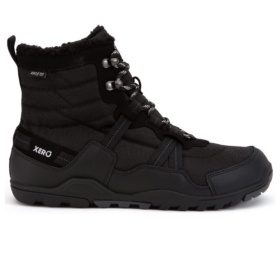
Xero Shoes Alpine Black Men
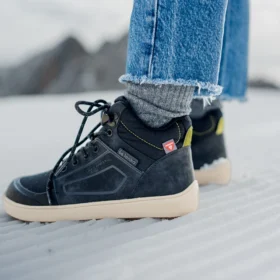
Be Lenka ArcticEdge Charcoal Black
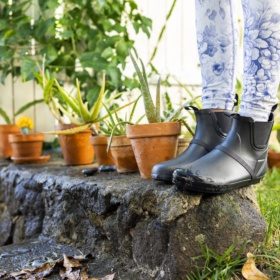
Xero Shoes Gracie Black Women rubber boots
Winter boots built to last
The global footwear industry contributes about 0.45% of total global emissions – less than previously feared, but still worth addressing. Your next pair of winter boots is a chance to vote with your wallet for durability, simplicity, and lower impact.
Barefoot winter boots combine low-impact materials, durable construction, and foot-healthy design. You’ll find options for the whole family – from kids’ boots and rubber boots with room to grow to women’s and men’s styles built for years of cold-weather wear. Brands like Peerko partner with physiotherapists to design shoes using high-quality European materials.

At Mugavik, we’re serious about sustainability: we repack orders into smaller boxes to cut shipping emissions by up to 50%, reuse nearly every shoebox from our store, and seal parcels with paper tape instead of plastic. 90% of our shipments go out without extra packaging because shoes don’t need bubble wrap to arrive safely.
Choose footwear that respects your feet and the planet. Browse barefoot winter boots designed to last, and step lighter this winter.